
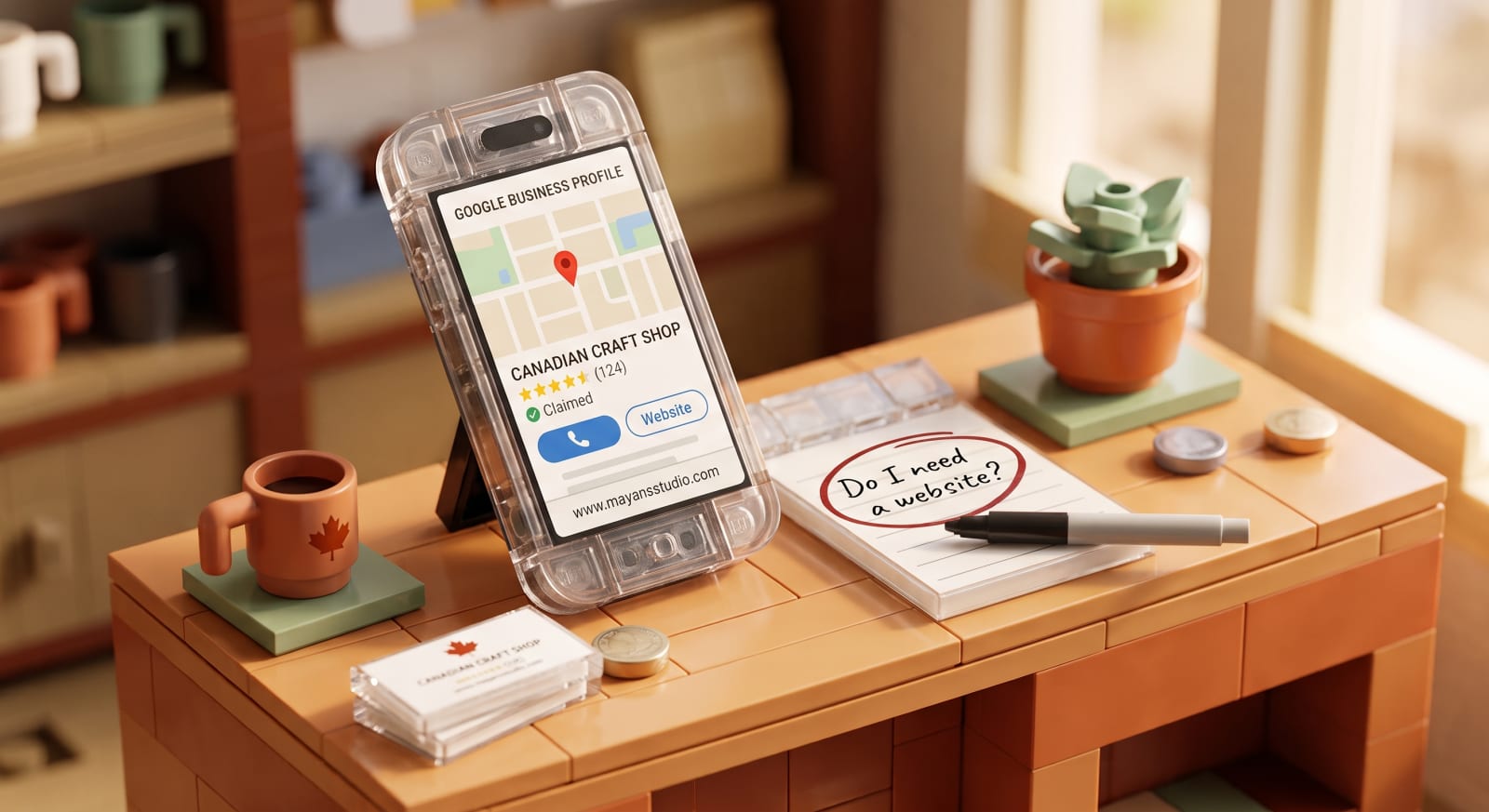
The honest answer is: sometimes no. Which is not what a marketing studio is supposed to say, so let me be specific about when.
When a Google Business Profile alone is genuinely enough
There is a real category of business where a full website is not the next best dollar:
You are booked out and your problem is capacity, not demand. A trades business running a six-week waitlist does not need a website. It needs a better scheduling system.
Every customer arrives by referral or by walking past. A neighbourhood barber, a small cafe, a nail salon on a busy block.
Your entire offer fits on a profile. One location, one service, one price band, nothing that needs explaining.
You already sell somewhere else. If all your orders come through a marketplace, a booking platform, or Instagram, a brochure site adds a step rather than removing one.
If that is you, put the money into your profile, marketplace account or Instagram profile instead. Photos, hours, services and a steady stream of reviews will do more than a five-page site nobody reads. The Google Business Profile checklist covers what actually moves the needle there.
Four things a profile cannot do
For everyone else, here is where a profile stops.
It cannot rank for anything except you
A Business Profile competes for searches near you, in your category. It does not compete for "how much does a heat pump cost in Canada" or "what to check in a commercial lease". Those are the searches where people are still deciding, which is the cheapest possible point to reach them. You need pages for that, and a profile does not have pages.It cannot capture a lead on your terms
A profile gives you a call button and a message button. It does not give you a form asking the three qualifying questions that would have saved you a wasted site visit.It cannot hold your explanation
Services, pricing, process, common questions, credentials, the reason you are more expensive than the other quote. All of that has to live somewhere a customer can read at eleven at night without having to talk to you.You do not own it
This is the one that gets underestimated, and there is a precedent worth knowing about.
The business.site precedent
Google used to build free websites for businesses out of their Business Profile data, on addresses ending in business.site. A very large number of small businesses used them, because they were free and they took ten minutes.
In March 2024, Google turned them off. In Google's own words: "In March 2024, websites made with Google Business Profiles will be turned off and customers visiting your site will be redirected to your Business Profile instead. The redirect will work until June 10, 2024" (sourced from Search Engine Journal). After 10 June 2024, anyone clicking an old link got a page-not-found error.
Nobody did anything wrong. The landlord simply changed the terms. That is what building on rented ground looks like, and it is the same argument for owning a domain and a site as it is for not running your whole business through a single social account.
What "a website" actually has to mean
The word carries far more baggage than it should. A minimum viable website for a local business is roughly:
A domain you own, registered in the business's name, not your web person's. This is equivalent to your house address
A home page that says what you do, where, and for whom, before anyone has to scroll
A page per major service, if you offer more than one thing
A contact page with a real form that lands in an email inbox you own and which somebody checks regularly
Name, address and phone number matching your Business Profile exactly, character for character
Something that loads fast on a phone, because that is where it will mostly be read
That is it. Five or six pages. Not a rebrand, not a custom design system, not a platform your team needs training on. If you want to know how your current site scores against that list, the free website audit walkthrough is a decent hour's work with no cost attached. If it turns out you do need one, what a build actually includes is written out too.
The two are not competitors
A 2026 survey of 1,002 consumers found that 97 percent read online reviews for local businesses, and that after reading positive reviews, 54 percent go on to visit the business website (sourced from BrightLocal). Treat this exact figure as more of a guidance than something set in stone.
Directional is enough, because it describes the shape of the journey rather than the size of it. The profile gets you found and earns the first bit of trust. The site answers the questions the profile cannot fit, and captures the enquiry. Cut either one out and the other is left doing a job it was not built for.
If you do add a form, read this part
The moment you collect an email address and follow up with anything promotional, Canada's Anti-Spam Legislation is in play. Every commercial electronic message needs express or implied consent, clear identification of the sender, and a working unsubscribe mechanism. Someone submitting a form to ask you to quote a job has given implied consent for you to reply about that job. That is not consent to add them to a monthly newsletter. Keep the two separate, with a separate tick box, from day one. This is general guidance rather than legal advice, and worth a conversation with counsel if you are building a real list.
So, do you need one?
Ask it this way: is there a question customers ask you, over and over, that you cannot answer inside a Google Business Profile?
If yes, you need somewhere to put the answer. If no, you have better places to spend the money this quarter, and I would rather tell you that than sell you a site.