
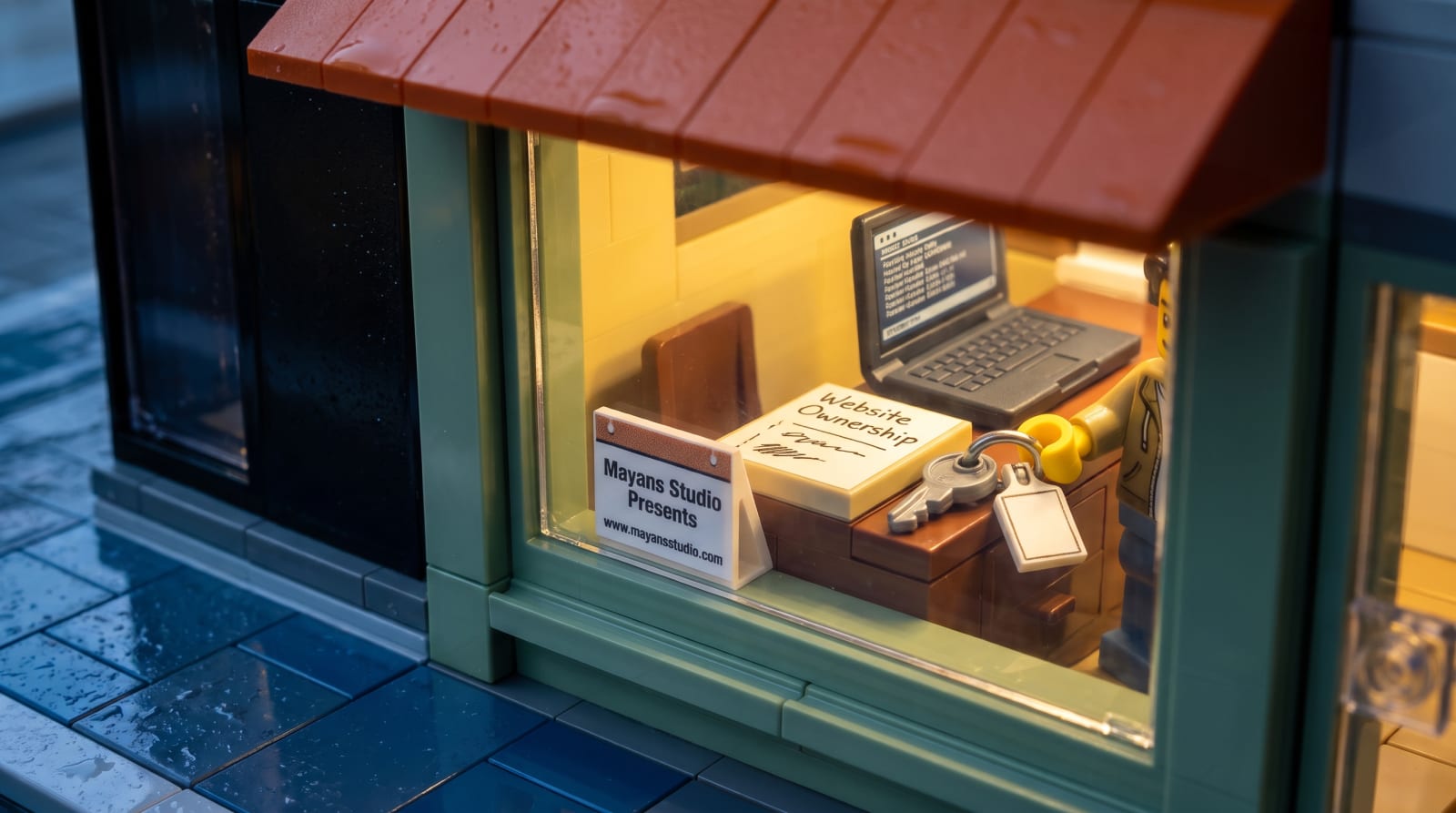
Does your web designer own your website? In Canada, the honest answer is: possibly more of it than you think, and it depends almost entirely on what you signed. Most owners only find out when they try to switch designers and discover the domain is in someone else's name.
This is general guidance on what to check, not legal advice. Anything contractual, or anything already in dispute, belongs with a lawyer.
Why the contract matters so much
Under Canada's Copyright Act, "the author of a work shall be the first owner of the copyright therein" (sourced from Justice Laws, Copyright Act s.13). The main exception is work made by an employee in the course of their employment. A freelancer or agency building your site is usually not your employee, so unless your agreement says otherwise, the designer may well own the copyright in the design and code they wrote.
The Act also says an assignment of copyright is not valid unless it is in writing and signed by the owner (same source, s.13(4)). A handshake, or an invoice marked paid, is not an assignment. And moral rights, the author's right to be associated with the work and to its integrity, "may not be assigned but may be waived" (sourced from Justice Laws, s.14.1), so a well-drafted agreement deals with those too.
The four things to own, and how to check each
1. The domain
This is the one that hurts most to lose. For a .ca domain, CIRA's WHOIS lookup shows the registrant name for non-individual registrants (sourced from CIRA). If the registrant is your designer's company rather than yours, ask your registrar to correct it. CIRA itself does not make changes; the registrar does. For a .com, the registrant details are held by your registrar, and you should be able to see them in your account.
To move a .ca domain, the authorization code has to be requested from the administrative contact's email on the domain, and the registrar must provide it within five calendar days of a valid request (sourced from CIRA). For a .com, the registrar must also provide the code within five days, and transfers can be blocked for 60 days after registration or a change of registrant (sourced from ICANN). ICANN has approved changes to those transfer rules, but at the time of writing no date has been set, so the 60-day rules still apply.
2. Hosting and CMS logins
You should have an administrator login to the hosting account and to the content management system, in your own name and email. Ideally the hosting is billed to your card. If it is bundled into your designer's monthly fee, ask whose account it sits in.
3. The design and the code
This is the copyright question above. Check your agreement for a clause assigning copyright to you on final payment, or at least a licence that lets you keep using, editing and moving the site. If there is no written agreement, that is worth fixing now, while the relationship is good.
4. Analytics, Business Profile and email accounts
Google Analytics, Search Console, your Google Business Profile and the email platform behind any newsletter form should all list you as the owner, with your designer added as a user. The Business Profile has its own traps, covered in who actually owns your Google Business Profile. For the email platform, make sure you can export the subscriber list along with its consent records: under Canada's Anti-Spam Legislation you need to be able to show consent for the people you email (sourced from the CRTC).
What to ask for before you pay the last invoice
The domain registered with your business as registrant, and the registrar login.
Administrator logins to hosting and the CMS, in your name.
A signed copyright assignment, or a written licence, covering the design and code.
Owner access to Analytics, Search Console, your Business Profile and the email platform.
A copy of the site files and a database backup, plus a list of any paid themes, plugins or fonts and whose licence they are under.
If you are rebuilding with someone new, this is also the list to hand them. It is a big part of what a website build should include when it is done properly: the client walks away owning everything.
If your designer has gone quiet
Start with the domain, because it controls everything else. If you are the administrative contact, request the authorization code from your registrar directly. If you are not, contact the registrar with proof of your business's identity. Then work through the list above in writing, keeping copies. If you are cancelling an ongoing arrangement, the notice terms matter too, and cancelling a marketing agency contract early covers what to look for. If it turns into a dispute, that is the point to call a lawyer.
So, if your designer stopped answering tomorrow, which of those four things could you get to on your own?