
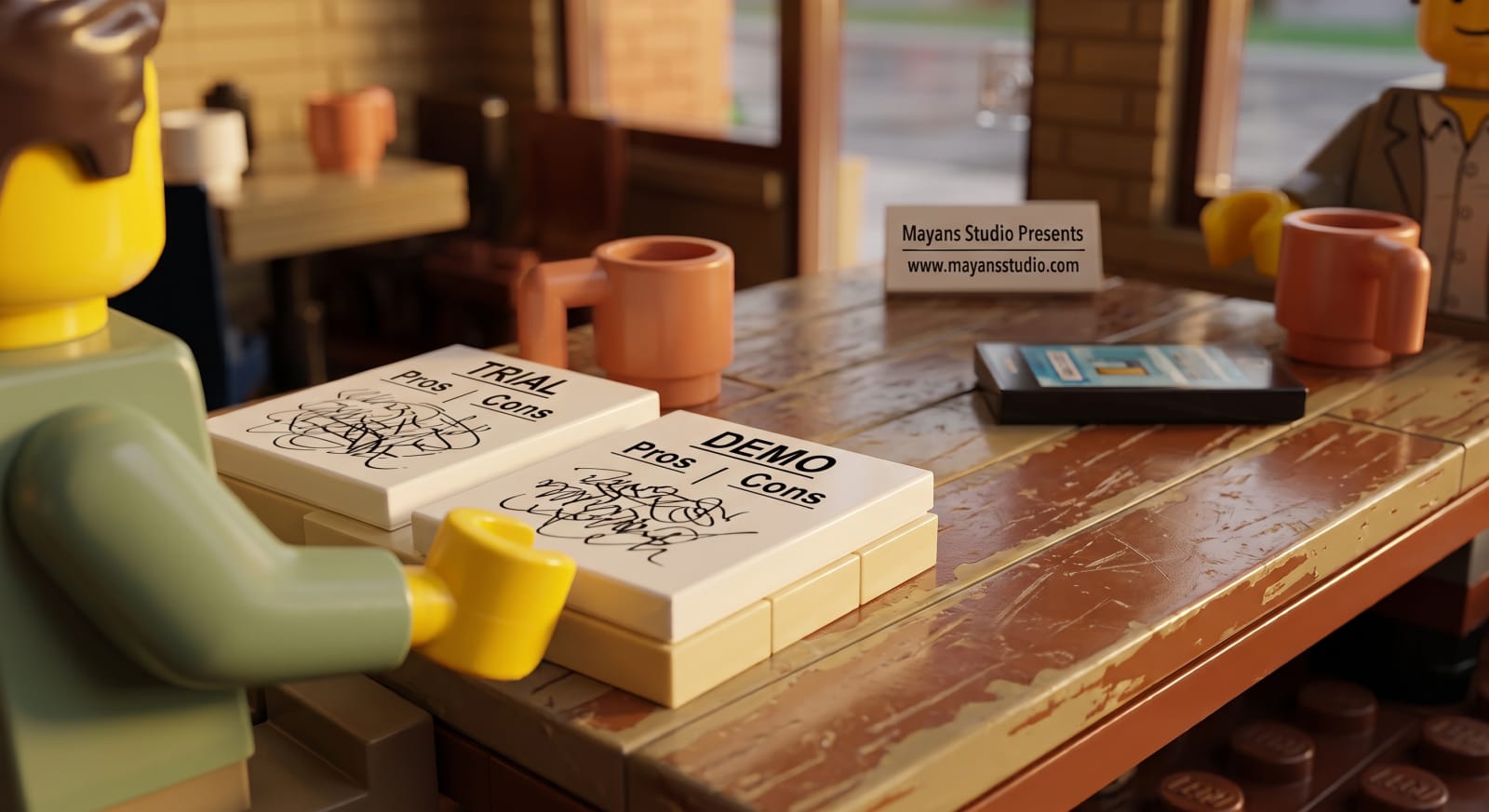
Free trial or book a demo gets argued as a philosophy, usually by people who have already picked a side. It is not one. It is a function of four fairly boring facts about your business, and once those are written down, the answer is normally obvious.
Why there are no conversion benchmarks in this post
You will have seen the figures: trial-to-paid rates, demo-to-close rates, the percentages that circulate in every deck about this decision. I went looking for ones that publish a sample size and a period, and could not find them. A benchmark without a methodology is a rumour with a decimal point, so none appear below.
What follows is a decision framework instead. It will get you further anyway, because your product is not the average of a survey you cannot inspect.
Question one: What is your average contract value?
This is the crudest filter and the most reliable. If a customer is worth a few hundred dollars a year, a human cannot profitably talk to every one of them, and a trial is the only sane path. If a customer is worth tens of thousands, a conversation is cheap relative to the deal, and a trial that nobody guides is a way to lose the ones you could have won.
The awkward middle is real, and it is where the other three questions do the work.
Question two: How long does your product take to show its value?
Some products are useful in ten minutes. Others need data loaded, a team invited, an integration connected, or a month of history before anything interesting happens. A trial only works when a buyer can reach the interesting part on their own, inside the trial window, without you.
If the honest answer is that your product is dull until week three, a fourteen-day trial is not a trial. It is a fortnight of watching people fail to see the point.
Question three: Can a buyer actually start without asking anyone?
This is the question founders skip, and it is usually the one that decides it. A self-serve trial assumes your user can sign up, connect your product to something that matters, and start putting real data in it, without a second person's approval.
In G2's 2026 Buyer Behaviour Report, published 22 July 2026, based on a survey of more than 1,000 B2B software buyers and decision-makers, IT security review was the single biggest source of delay, cited by 39 percent of buyers overall and rising to 50 percent among enterprise buyers (sourced from G2). The sample is not described as Canadian, so read it as direction rather than as your market. The point stands either way: if your product touches customer data, your trial is not really self-serve, because a security questionnaire is sitting between signup and use.
When that is true, a demo is not friction you are adding. It is the conversation that has to happen anyway, moved earlier, where you can help.
Question four: Can you staff demos every week this quarter and next?
A demo path is a promise about your calendar. Thirty enquiries a month means thirty conversations, and at the seed stage, those land on a founder. That is fine for a while, and it is genuinely the fastest way to learn what your buyer cares about. It stops being fine the week you are also shipping, hiring and raising.
Gartner's March 2026 release reports that 67 percent of B2B buyers prefer a rep-free experience, from a survey of 646 B2B buyers conducted from August to September 2025 (sourced from Gartner). Worth holding lightly: a stated preference is not a purchase, and the same release notes that buyer confidence is what tracks with deal quality. Read it as a warning against making a conversation compulsory, not as an instruction to remove yourself from the process.
What each choice does to the rest of your funnel
Whichever way you go, the decision does not end at the button. It moves work somewhere else.
If you lead with a trial
Your onboarding email carries the sale. Nobody is there to explain the product, so the sequence has to do it.
Your signup page does the qualifying that a sales call would otherwise do, which is a design problem more than a form problem. What makes a trial signup page actually convert covers the page itself.
Sales follow-up should be triggered by what an account does in the product, not by how many days have passed.
A CASL note, because this is where it bites. A trial signup that starts a follow-up sequence is sending commercial electronic messages. You need consent, clear identification of the sender, and an unsubscribe mechanism that remains valid for at least 60 days and is honoured without delay, no later than 10 business days (sourced from the CRTC). Marketing guidance, not legal advice, and worth a lawyer's half hour before you scale it.
If you lead with a demo
Your pricing page has to do far more work, because it is where the buyer decides whether the conversation is worth booking. What your pricing page has to do before a demo is the whole argument.
Your response time becomes a conversion factor. A booking link that offers nothing sooner than next Thursday is a leak.
Your security and trust content stops being a footer link and starts being part of the sale.
You need a plan for the enquiries that are not a fit yet, or your calendar fills with conversations that were never going to close.
The hybrid that is usually not one
Putting both buttons on the page feels like keeping your options open. Mostly, it just moves the decision onto the visitor, who has less information than you do. If you genuinely serve two segments, say so and give each one its own path with its own page. If you are hedging because you have not decided, the page will read exactly like that.
So, which one
Write down the four answers. Contract value, time to value, whether a buyer can start alone, and whether you can staff the conversations. In my experience, three of the four point the same way, and the fourth is the one you were hoping to ignore.
Which one is it for you?